
Digitalisation is an Opportunity, Not a Cost: How to Grow Your Company and Access Non-Repayable Grants
Why Digitalisation Is No Longer Optional in 2026
There is a deeply entrenched perception in Romanian entrepreneurial circles: digitalisation costs money, takes time, and is a problem for large companies. This perception is not only wrong today — it is dangerous. The 2026 data are clear: Romania is approximately 10 years behind the European average in digitalisation, and Romanian SMEs are up to 3 times less productive than their Western European counterparts.
Only 5% of companies in Romania use automation and artificial intelligence solutions, compared to over 33% in countries such as Denmark, Finland, or Sweden. This difference is not just a statistic — it translates into lost orders, dissatisfied customers, excessive administrative costs, and the inability to scale. And yet, at the same time, there is an extraordinary opportunity: non-repayable European Funds that can cover between 50% and 90% of the cost of a digitalisation project.
Digitalisation is no longer a cost. It is an investment with a demonstrated return — and one that can be largely financed with European money.
1. What Digitalisation Really Means for a Romanian SME
Digitalisation does not mean buying new laptops or switching to PDF invoices. It means transforming the way your company produces, sells, delivers, and communicates — with the help of technology. Concretely, for a Romanian SME, digitalisation means:
- Automating repetitive processes (accounting, reporting, order management etc.) with RPA (Robotic Process Automation) and AI Agents
- Implementing a CRM system that centralises client relationships and automates follow-ups
- Adopting an ERP that provides real-time visibility into stocks, costs, and cash flow
- Using a ChatBot or conversational AI Agent that manages customer relationships 24/7
- Connecting all systems (e-commerce, ERP, accounting, logistics) for end-to-end automated flows
Each of these solutions has a direct and measurable impact. Experts emphasise that SMEs that do not automate basic processes risk entering survival mode in the next 3-5 years. The message could not be clearer.
2. Why Digitalisation Is, First and Foremost, an Opportunity
2.1. Demonstrated ROI: Concrete Gains, Not Promises
Studies show that over half of SMEs that have implemented digitalisation solutions report an impact of over 30% on their turnover. And companies that combine RPA with AI Agents report an ROI of 250–380%, with investment recovery in 6–9 months.
Concretely, for an SME with 20–50 employees, automation can bring:
- 40–60% reduction in time spent on financial processes (invoice processing, bank reconciliations)
- 15–25% increase in sales conversion rate (through automated CRM and lead scoring)
- 30–50% reduction in call and email volume in customer service (through AI ChatBot)
- Savings of 120,000–250,000 RON annually in direct operational costs
2.2. Competitiveness and Scalability Without Linear Costs
A digitalised company no longer grows linearly (more employees = more output). It grows exponentially: the same human resources can manage 3–5x larger volumes, thanks to automation. This means you can take on more clients, enter new markets, and scale without proportional hiring.
2.3. Automatic Regulatory Compliance
e-Invoice, e-Transport, SAF-T — the mandatory digital regulations in Romania are not just a bureaucratic burden. They are a forced entry point into digitalisation. SMEs that have implemented integrated solutions for these obligations have discovered, in practice, that automating fiscal reporting has freed up 15–20 hours per month in finance departments.
3. Non-Repayable Grants Available in 2026: The Money Is There, It Just Needs to Be Accessed
3.1. PNRR – SME Digitalisation (€20,000–€100,000)
Through Component 9 of the PNRR, non-IT SMEs in Romania can access grants of €20,000–€100,000 for the acquisition and implementation of digital solutions. The latest guide amendment (MIPE Order 116/2026) extended the implementation deadline to 29 May 2026.
Eligible expenditure:
- ERP, CRM, WMS, BI software licences
- RPA and software automation solutions
- Chatbots and conversational AI Agents
- Implementation, configuration and integration services
- Training and consultancy for the team
3.2. Regional Programmes (PR Vest, PR Nord-Vest, PRBI, etc.)
In addition to the PNRR, regional programmes are launching calls in 2026 dedicated to SME digitalisation, with grants between €10,000 and €200,000 and financing rates of 70–100%, depending on company size and implementation region. For example, PRBI 1.7 targets SMEs from Bucharest-Ilfov with grants of up to €200,000 for digitalisation.
3.3. DIH4Society – Free Digitalisation for SMEs (2026 Calls)
The European Digital Innovation Hub DIH4Society launched three selection calls in January 2026 through which SMEs from the North-West Region can benefit from free digitalisation services, AI solution testing, and technological consultancy.
3.4. PoCIDIF – Intelligent Growth, Digitalisation and Financial Instruments Programme
The PoCIDIF Operational Programme funds research, innovation, and digitalisation projects, with special focus on the adoption of advanced technologies in SMEs. Active calls in 2026 target automation, AI, and cloud solutions.
4. What a Funded Digitalisation Project Looks Like in Practice
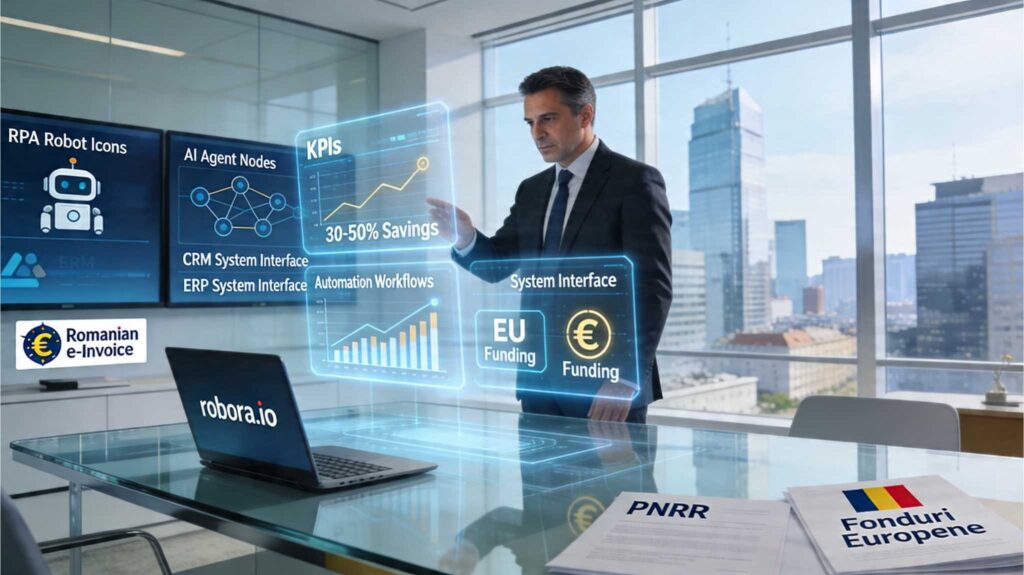
The most common scenario for a Romanian SME accessing European funds for digitalisation looks like this:
Step 1: Digital audit and identification of priority processes: Assessment of current processes and identification of those with the greatest automation potential (finance, customer service, logistics etc.).
Step 2: Defining the technical architecture: Choosing the right solutions (RPA, CRM, ERP, ChatBot etc.) and planning integrations with existing systems.
Step 3: Preparing the funding application: Drafting the business plan, technical documentation, and eligible budget in accordance with the call guidelines.
Step 4: Implementing the solutions: Deploying, testing, and integrating solutions into company processes, respecting contract deadlines.
Step 5: Training and continuous optimisation: Team training, KPI monitoring, and continuous optimisation of automated flows.
5. Common Mistakes That Lead to Project Rejection or Poor ROI
- Exclusive focus on hardware — servers and laptops without automation software that brings real ROI
- Generic, copy-paste documentation that does not reflect the real specifics of the company
- Choosing a technical partner without experience in funded projects (late delivery, non-compliance risk)
- Automating poorly defined processes — ‘robotising chaos’ does not bring efficiency
- Lack of internal team involvement — solutions are not adopted, ROI remains on paper
How ROBORA Can Help: From Digitalisation to Non-Repayable Grants, with a single partner
ROBORA is your complete strategic partner for digital transformation — on both the technical and financial dimensions. We offer two complementary categories of services:
🔹 Automation and Digitalisation Services (RPA, AI Agents, ChatBots, CRM, integrations):
We design and implement intelligent automation solutions tailored to your exact processes — from software robots for intern processes, to conversational AI Agents that manage customer relationships 24/7.
🔹 Consultancy for Accessing Non-Repayable Grants for Digitalisation:
We help you identify the right funding line (PNRR or any other regional programmes), prepare eligible technical documentation, and manage the project from submission to implementation and final reporting.
Through ROBORA, digitalisation becomes accessible and funded. The cost excuse no longer exists!
👉 ROBORA Services: https://robora.io/en/services/
👉 Non-Repayable Grants: https://robora.io/en/non-refundable-funds/
📩 Want to find out how this applies to your company? Contact us today for a free analysis:
👉 https://robora.io/en/contact-us/
Conclusion: The Time Is Now — and the Money Is Available
Digitalisation has never been more accessible and better funded than in 2026. European non-repayable funds exist, the guidelines are clear, and the technology is mature with demonstrated ROI. Companies that act now will build a durable competitive advantage. Those that wait risk remaining trapped in an outdated operational model, unable to cope with market pressures.
Digitalisation is not a cost. It is your best-funded opportunity of 2026!