
In an increasingly digitized business environment, process automation no longer means just the automatic execution of repetitive steps.
Our team offers complete Intelligent Automation solutions, combining the power of Robotic Process Automation (RPA) with the advanced capabilities of AI Agents, to streamline and optimize business processes at any level of complexity.
At ROBORA, we implement two complementary automation technologies:
RPA (Software Robots)
Ideal for repetitive, structured, and clear well-defined rule-based business processes.
Agentic Automation (AI Agents)
suitable for complex processes involving interpretation, contextual analysis, decision-making, and dynamic adaptation
We don’t believe in one-size-fits-all solutions. Each company has different processes, systems, and goals. Therefore, we deeply analyze each client’s context and choose the optimal automation solution: RPA, AI Agents, or a hybrid approach that combines both technologies into a coherent intelligent automation ecosystem, offering companies agility, efficiency, and a real competitive advantage.

What we deliver to our clients:
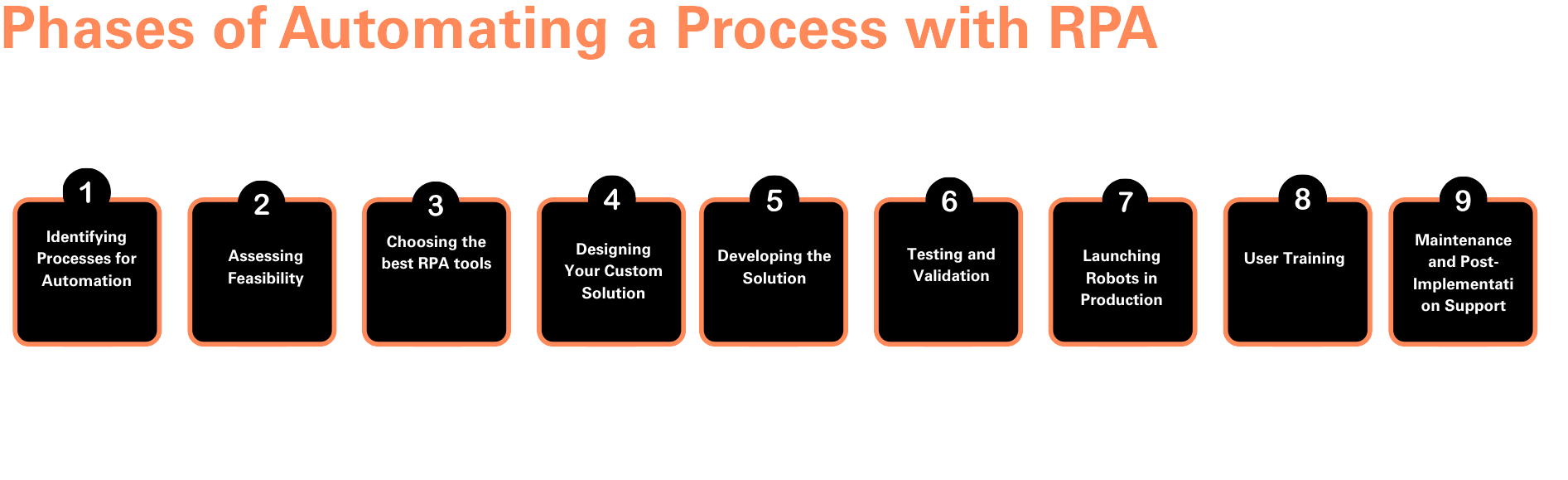
At ROBORA, process automation through RPA and AI Agents involves a detailed analysis of existing workflows. We identify repetitive tasks, optimize them, and implement Intelligent Automation solutions – Software robots and/or AI Agents – to handle them automatically. This process includes:
1. Identify Processes for Automation
- We start by analyzing which processes in your company can be automated. We look for repetitive and time-consuming tasks that software robots or AI agents can do faster and error-free, evaluating whether the process requires rule-based automation (RPA) or contextual intelligence and decision-making (AI Agents).
2. Assessing feasibility
- We make sure everything is feasible! We conduct a detailed process analysis and a Case Study to convince us that the proposed solution will work perfectly for you. We deliver manual vs. automated process comparative analyses, cost-benefit analyses, and a small demo (Proof of Concept) to demonstrate the technical feasibility and benefits of the automation solution.
3. Choosing the best tools
- There are many tools used in automation. We help you choose the right option for your needs and infrastructure.
4. Designing the customized solution
- Every business is different, so we design the customized automation solution for you step by step. We make sure all process steps are clearly documented and that we cover all exceptions.
5. Developing the Solution
- This is the technical part. We create the automation solution – Software robots and/or AI Agents – that precisely follows your automated process, and then we carefully test them to ensure they work correctly.
6. Testing and validation
- Before launching the solution into production, we test it in real conditions, simulating the work environment. Then, we ask for your final feedback to make sure everything is perfect.
7. Launching the Solution in production
- Once everything is validated, we launch the automated solution in the real work environment. We closely monitor the first few days to ensure it works flawlessly.
8. User Training
- We provide training to your team so everyone knows exactly how the automation solution works and what to do in case of potential errors or exceptions.
9. Maintenance and Post-Implementation Support
- Once the solution is implemented, we take care of maintaining the robots and/or AI agents and adjusting them to any changes in the process. We are here to help you with optimizations whenever needed!

RPA (Robotic Process Automation)
RPA is a technology that enables the automation of repetitive and rule-based tasks, giving companies the ability to optimize processes without interfering with existing systems. RPA robots interact with applications and systems just like human employees, but they do it faster, error-free, and run 24/7. The RPA solutions offered by ROBORA are flexible and scalable, adapting to the needs of each client, regardless of process complexity.
RPA forms the foundational layer of automation, being ideal for processes with clear rules and structured data, and works excellently in synergy with AI Agents for processes that also require advanced cognitive capabilities.
Whether it’s attended robots (assisting employees with specific tasks) or unattended robots (working independently), automation through RPA reduces execution time, increases productivity, and ensures necessary regulatory compliance. Benefits include improving the experience of employees, who can focus on more valuable tasks, and a significant reduction in operational costs.
Here is a list of some business processes automatable with RPA, organized by department, including examples and benefits:
Here are some real-world examples of economic benefits, expressed in number of man-days per year, and the percentage the robot takes over from human operators for various business processes automatable with RPA:
These examples demonstrate how RPA can bring significant benefits in terms of time savings and operational efficiency. The percentage of activity taken over by robots ranges between 70% and 90%, which allows employees to focus on higher value-added activities.
AI Agents (Agentic Automation)
AI Agents represent the next generation in the evolution of process automation. Unlike RPA robots that execute predefined tasks based on fixed rules, AI Agents are autonomous systems capable of understanding context, making complex decisions, continuously learning from experience, and adapting to new situations without human intervention.
This technology transforms the way companies automate business processes, moving from fixed rule-based automation to cognitive automation. AI Agents do not just execute – they understand, think, and act autonomously, handling exceptions, optimizing decisions, and collaborating with other AI agents and/or human operators to achieve complex objectives.
Key capabilities of AI Agents:
- Autonomy and decision-making: AI Agents can make contextual decisions without requiring human intervention for every situation. They evaluate options, anticipate consequences, and choose the optimal course of action based on objectives.
- Continuous learning and adaptability: Unlike RPA, AI Agents learn from every interaction, improving their performance over time and adapting to changes in the work environment without reprogramming.
- Contextual intelligence: They process and understand unstructured data (emails, documents, conversations, images, etc.), not just structured data from forms or databases.
- Multi-agent collaboration: AI Agents can work together, coordinating complex activities, sharing knowledge, and forming dynamic orchestration networks to solve complex problems.
- Exception management: They can handle unforeseen situations, improvise solutions, and escalate intelligently only when human intervention is truly necessary.
- Natural language interaction: They communicate fluently with users, understand complex intents, and provide contextual and personalized responses.
When AI Agents are ideal:
- Processes requiring interpretation and contextual understanding (e.g., customer feedback analysis, triaging and resolving complex requests, evaluating legal documents)
- Complex decisions based on multiple criteria and unstructured data (e.g., credit approvals, technical problem diagnosis, investment prioritization)
- Interactions with clients and employees that require empathy and personalization (e.g., advanced customer support, personalized onboarding, sales assistance)
- Processes that evolve frequently and require rapid adaptation without reprogramming
- Scenarios with frequent exceptions requiring judgment and creativity
- Continuous optimizations and permanent process improvement
Here is a list of some practical AI Agent use cases, organized by department, including the business benefits delivered:
Discover your business’s automation potential for free.
Fill out the form and receive a dedicated analysis of the processes that can be streamlined through Intelligent Automation – RPA and/or AI Agents – in your company.
By using the SEND button below, you accept our personal data privacy policy.