
Business Process Automation in Romania: RPA and AI Solutions

Business process automation in Romania is moving beyond simple repetitive-task automation. Today, companies can combine Robotic Process Automation (RPA), AI Agents, APIs, document processing and existing business applications to automate complete workflows, from data intake and validation to system updates, customer communication and controlled decision-making.
The most effective approach is not to start with a technology and search for a use case. It is to start with the business process, the desired outcome and the constraints of the existing IT environment. Some processes are ideal for RPA, others benefit more from AI Agents, while complex workflows often require a combination of both. ROBORA approaches automation in this way: it starts with the process and the business objective, then determines the appropriate technology and architecture.
What does business process automation actually mean?
Business process automation means using software to execute one or more steps of a business workflow with limited human intervention where human involvement does not add value. A serious automation project is therefore more than building a software robot. It involves understanding the workflow, removing unnecessary steps, connecting systems, handling exceptions and measuring the business result.
Depending on the process, the solution may include RPA robots, AI Agents, APIs, document processing, business rules, databases and applications such as CRM and ERP. The right architecture depends on how structured the process is, how many exceptions it contains and how much interpretation is required.
RPA or AI? The distinction that matters for business
| Technology | Best suited for | How it works |
| RPA | Repetitive, structured, rule-based work | Executes defined steps across applications and systems. |
| AI Agent | Context, interpretation and decision-making | Analyzes information and selects actions based on objectives and context. |
| RPA + AI | Complex workflows combining interpretation with deterministic execution | AI interprets and decides; RPA executes actions in business systems. |
Consider invoice processing. An AI Agent can read an incoming message, extract the relevant information, identify missing data and determine the next step. An RPA robot can then enter validated information into an ERP and complete a sequence of repetitive operations. The value comes from the combination, not from treating every problem as an AI problem.
Which business processes can companies in Romania automate?
The strongest automation opportunities usually appear where there is significant workload, repeated manual activity, clear rules, many documents or data moving between multiple systems.
- Finance and accounting: invoice data capture, validation, reconciliation, document generation, system updates, and others.
- Sales: CRM data entry, lead qualification, quote preparation, follow-up workflows, and others.
- Human resources: document handling, data updates, recurring administrative workflows, and others.
- Customer service: request classification, information extraction, first-line responses, escalation when a human decision is needed, and others.
- Operations and logistics: order processing, data checks, synchronization between systems, reporting, and others.
- Legal and real estate: extracting information from documents, generating standardized documents, validating data, and others.
- IT and support: ticket classification, incident analysis, repetitive operational tasks, and others.
What does a well-designed automation project look like?
A reliable automation project starts with process analysis, not software selection. The objective is to understand the current workflow, identify bottlenecks and define the expected result before development begins.
- Process analysis – map the steps, rules, exceptions, systems and workload.
- Feasibility assessment – estimate technical complexity, implementation effort and business impact.
- Technology selection – choose RPA, AI Agents, APIs or a hybrid architecture.
- Solution design – define integrations, data flows, access rights and exception handling.
- Development and testing – build the solution and validate it against realistic scenarios.
- Production deployment – introduce the automation in a controlled way and monitor early operation.
- Maintenance – update the solution when applications, rules or business processes change.
Automating without replacing the existing IT infrastructure
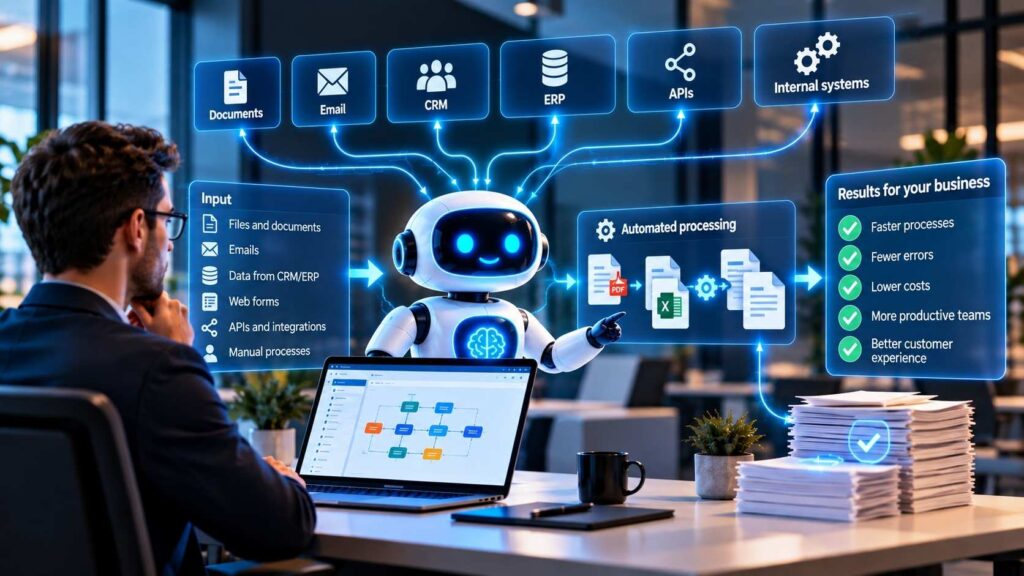
A common concern is that AI or RPA requires a company to replace its ERP, CRM or other core systems. In almost all cases, that is not necessary. The automation layer can be built around the existing environment, using APIs and direct integrations where available, and RPA where older applications do not expose suitable integration options.
This matters in Romania, where companies often rely on a mix of local applications, legacy systems and newer cloud platforms. A well-designed automation strategy can connect these components while avoiding an unnecessarily expensive system replacement project.
Security and control must be designed from the start
An RPA robot or AI Agent that can access business information and applications becomes part of the company’s operational environment. Access therefore needs to be controlled, activities should be auditable and sensitive actions should follow explicit rules and, where appropriate, human approval.
- Controlled access and clearly defined identities.
- Data protection rules for sensitive or confidential information.
- Activity logs that make important actions traceable.
- Monitoring for errors, exceptions and abnormal behavior.
- Human approval for high-impact financial, legal or operational actions.
How much does automation cost, and how should ROI be measured?
The cost of business process automation depends on process complexity, integration requirements, workload, data volume, customization and security needs. A credible estimate therefore follows process analysis rather than being based only on a feature list.
ROI should be linked to measurable outcomes: hours of work released, processing time, error reduction, throughput, compliance with service levels and, where relevant, revenue impact. The most useful projects define those metrics before development starts and compare them with the real result after deployment.
What should you look for in an automation partner?
Technical configuration alone is not enough for high-impact automation. The partner should understand the business process, design integrations, manage exceptions and provide support after production deployment.
- Practical experience with RPA, AI and system integration.
- The ability to assess a process before proposing a technology.
- A solution designed around the existing IT environment.
- Testing, documentation and post-deployment maintenance.
- Evidence of delivered projects and measurable outcomes.
ROBORA: intelligent automation for real business processes
ROBORA designs and implements Intelligent Automation solutions using RPA, AI Agents and hybrid architectures. The approach starts with the client’s process: identifying opportunities, assessing feasibility, designing the solution, developing and testing it, moving it into production and providing ongoing maintenance.
Automation services: robora.io/en/robotic-process-automation/
ROBORA‘s public portfolio includes, for example, a regional distributor project in which order and inventory automation reduced processing time by 85%, with ROI reported at five months, as well as a conversational AI Agent designed for medical clinics. These examples show how automation can target complete operational workflows rather than isolated tasks.
Explore ROBORA’s portfolio: robora.io/en/portfolio/
Frequently asked questions
What is the difference between RPA and an AI Agent?
RPA is primarily suited to repetitive, rule-based execution. An AI Agent can interpret information, understand context, and determine what action should be taken. Complex workflows can use both.
Do we need to replace our ERP to introduce RPA or AI?
No. In almost all cases, the automation is integrated around the existing environment through APIs, connectors or RPA.
Which processes should we automate first?
Start with processes that have meaningful volume, repetitive work, clear rules and measurable impact on cost, speed, quality or customer experience.
How do we know whether automation will be profitable?
Compare the implementation and operating cost with measurable benefits such as time saved, error reduction, additional throughput and other business outcomes. The assessment should be made before development.
Want to see which processes in your company can be automated?